LEGO can be an excellent way to introduce children to robotics. The important question is not whether a class uses LEGO. It is what your child learns to do with it.
A one-off workshop can be a fun first experience. But if you are choosing ongoing robotics for kids in Singapore, look beyond the finished model. Does your child learn to build, code, test, explain and improve? Is there a clear next step after the first project?
Use this parent-facing checklist to tell a structured robotics education from a session focused mainly on following instructions.
Start with the right distinction
A guided build is not automatically a “template workshop”, and a template is not automatically a bad experience. Instructions can help beginners learn how parts fit together. LEGO is also used in serious robotics learning: Science Centre Singapore’s National Robotics Competition includes categories where students build and program autonomous robots.
The difference is the learning journey. In a strong programme, building is one step in a process: children use code and engineering ideas to solve challenges, then test and refine their work. A one-off activity may be worthwhile for exploration, but it should not be presented as a complete learning pathway unless it has one.
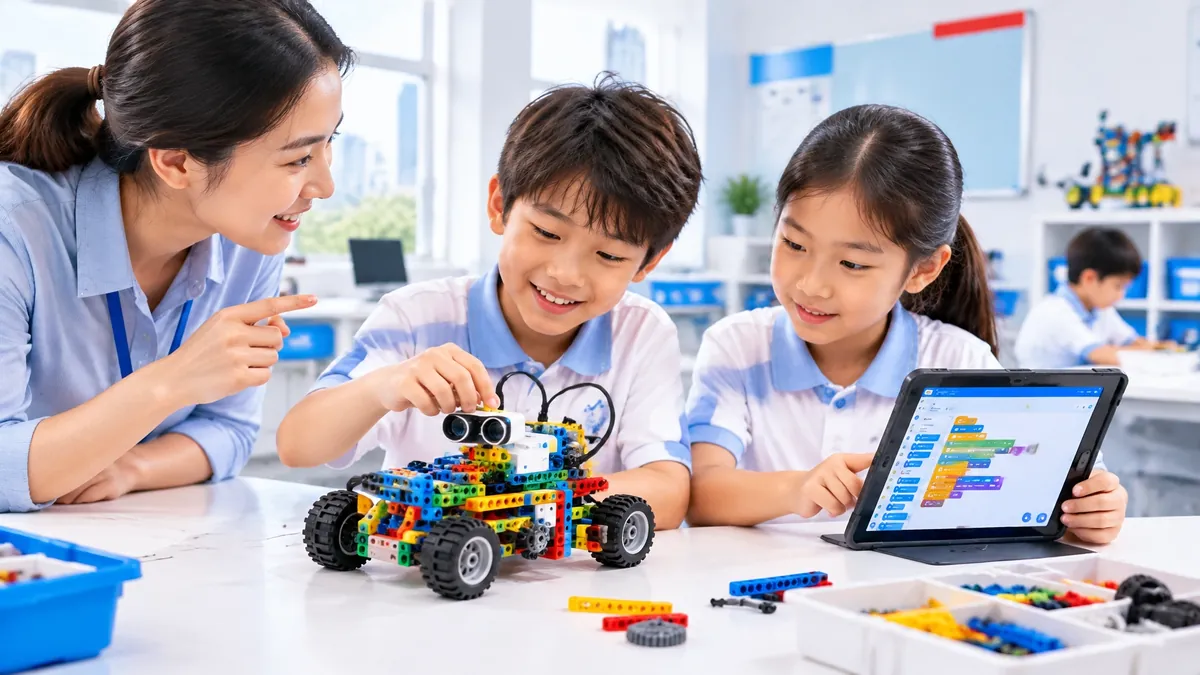
Your checklist: 8 signs of meaningful robotics learning
1. You can see a progression
Ask what your child will learn after the introductory project. A structured course should be able to show how skills develop over time: from basic construction and sequencing to coding, sensors, problem-solving and more independent projects.
Ask: “What will my child be ready to do next, and how does the next level build on this one?”
If the answer is only a list of different models, ask what new skills each model teaches.
2. Your child does the thinking, not just the building
Young learners may need step-by-step guidance at first. The goal is for them to understand the build, make choices and gradually take greater ownership, not simply copy a finished design.
During a trial, notice who is handling the parts. Is your child assembling, adjusting and making decisions? Or is the instructor doing the difficult steps while the child watches?
Look for: A teacher who gives hints and asks useful questions rather than taking over.
3. Coding has a purpose
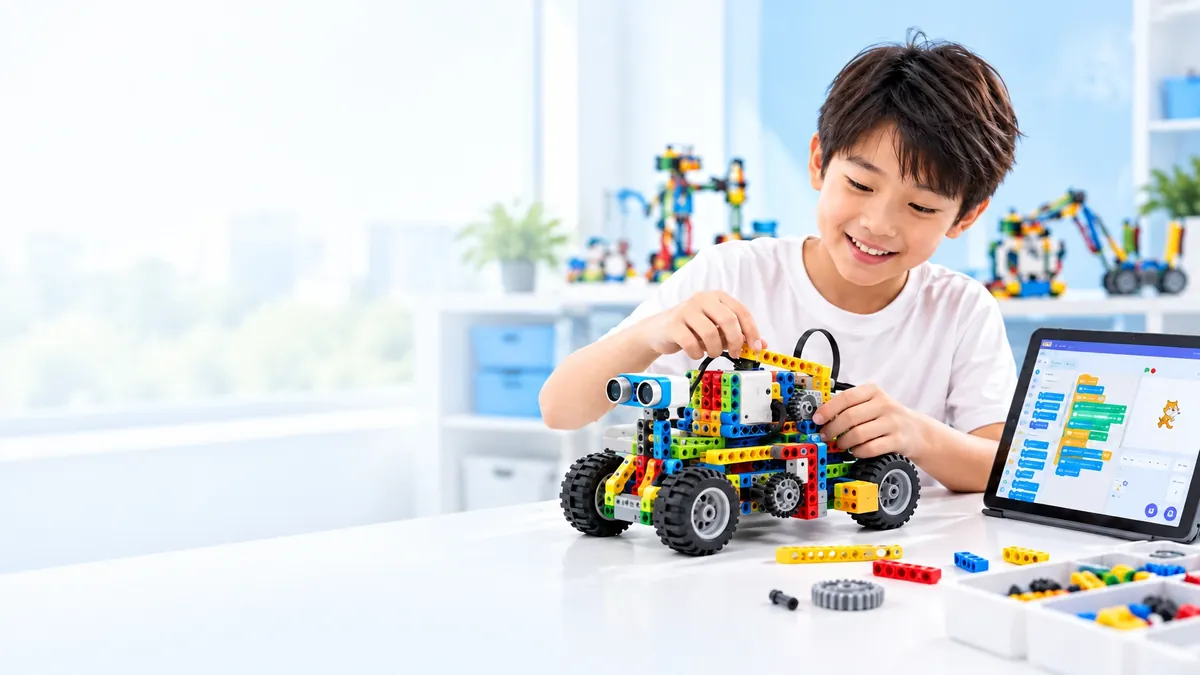
A class does not become a coding lesson just because a tablet is present. Your child should be able to connect a program to what the robot does: changing an instruction should change the result.
As children progress, they may work with ideas such as sequences, loops, conditions and sensor inputs. For example, they might program a robot to react when a sensor detects an object, then investigate what happens when they change the code.
Ask: “What will my child code today? Can I see a sample programme or hear how the code connects to the robot?”
4. Testing and debugging are part of the lesson
Robots do not always behave as expected. That is a learning opportunity. Children should get time to observe what happened, identify a possible cause and try a change.
A useful routine is:
Predict → Build or code → Test → Observe → Improve
This is more valuable than watching the instructor fix the robot and moving on. It helps your child practise patience, logical reasoning and problem-solving.
Look for: Time to test, revise and try again, not just a rush to finish the build.
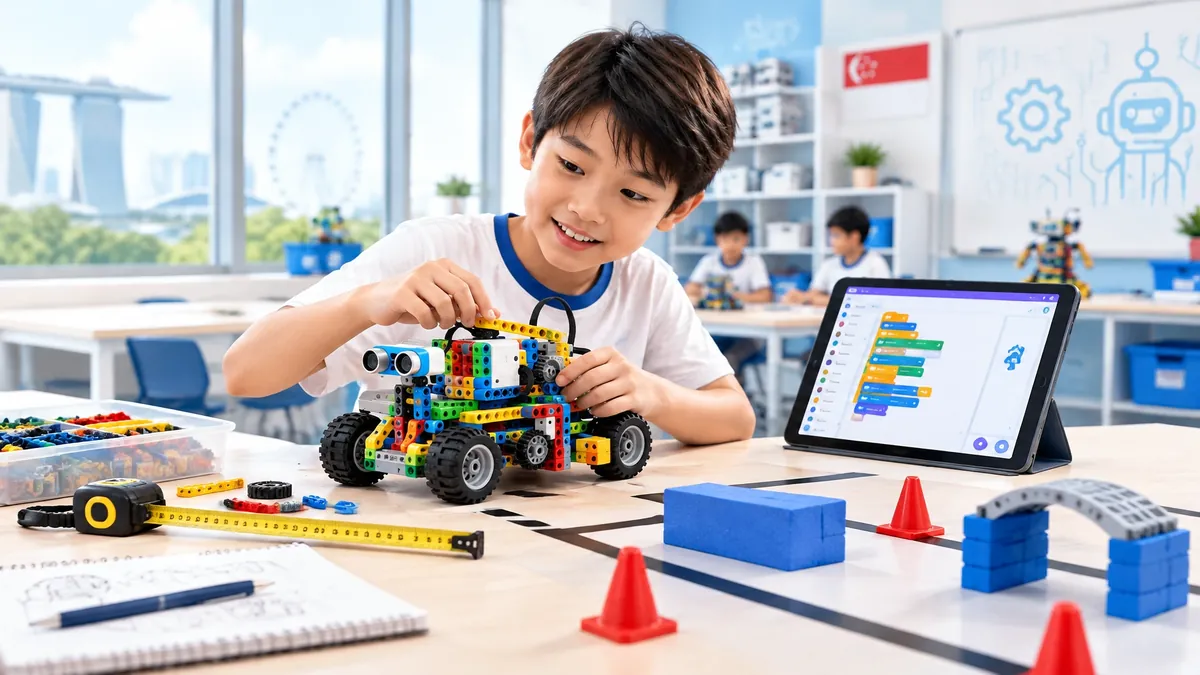
5. Projects connect to real ideas
A robot can make science, maths and engineering concepts easier to see. Wheels and gears can introduce motion and mechanical advantage. A moving mechanism can prompt questions about force, balance or speed. A sensor can help explain how a robot responds to its surroundings.
Ask the provider to explain the idea behind a project in plain language. A finished model matters less than whether your child can describe what it does, and why.
Ask: “What concept is this project teaching, and how will my child explore it?”
6. There is room to change the design
A guided build can be a sensible starting point. Over time, children should also have chances to modify a design, solve a new challenge or explore more than one solution.
The aim is not to make every lesson completely unstructured. It is to give children increasing opportunities to apply what they know instead of relying on identical instructions every time.
Look for: Small design choices or challenges that let children test their own ideas.
7. The teacher supports without rescuing
In a productive robotics class, children get support when they are stuck, but they still have time to think and try. Watch how the instructor responds when a robot fails. Do they explain every fix, or help the child find the issue?
Also ask about class size, kit sharing and who teaches the regular lessons. These details affect how much hands-on support your child receives.
8. The provider can show how progress is measured
A take-home model or completion certificate can be a nice memento, but neither tells you what your child can now do. Ask how instructors track progress and what evidence families can see.
That could include learning objectives, a project record, teacher feedback, a rubric or a child explaining their code and design choices.
Ask: “How will I know what my child has learned and what they are ready to work on next?”
A quick way to assess a trial class
Use this simple scorecard. Give each item 0 for not evident, 1 for partly evident or 2 for clearly evident:
- There is a learning pathway beyond today’s session.
- Children build and make decisions themselves.
- Coding controls or changes the robot’s behaviour.
- Children test and debug their work.
- The project connects to a science, maths or engineering idea.
- Children have opportunities to modify or improve a design.
- The instructor guides rather than takes over.
- The provider can explain how progress is tracked.
A low score does not automatically mean the activity has no value. It may simply be a recreational introduction. The key is to match your expectations: choose a workshop for a first taste; choose a progressive programme when you want sustained learning.
What a structured pathway can look like
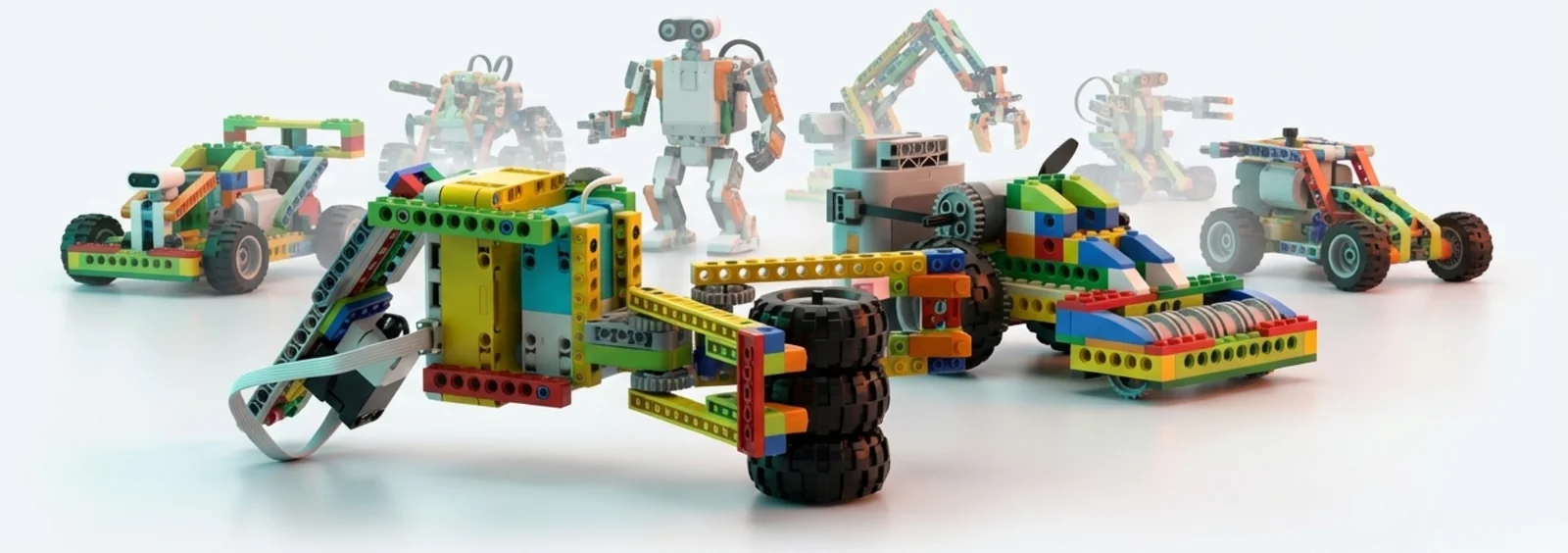
At Meta Robotics, the curriculum is built around 600+ proprietary robotic models and 20+ modules, with activities tied to science, maths and engineering concepts. The intent is to connect each build to what children are learning, and to give them new projects through which to practise and extend those ideas.
A lesson can move through stages such as Concept, Construct, Code, Compute and Compete: encounter an idea, build a model, program it, examine the result and apply learning in a challenge. The exact activity will vary with a child’s age and level, but the aim is continuity, not a string of unrelated builds.
You can explore examples of the engineering concepts behind selected Meta Robotics models, or see how an age-specific programme connects robotics, coding and STEM in the Ace programme explainer.
Questions to ask before you enrol
Bring these questions to a centre visit or trial:
- What will my child be able to build, code and explain by the end of the first term?
- How does the learning progress after this class?
- How much time will my child spend building, coding and testing independently?
- What happens when a robot does not work as expected?
- How are projects adapted for different ages or experience levels?
- What is included in the fee, and are there extra costs for materials or activities?
- Can I see a sample lesson, learning objective or progress update?
A clear provider should be comfortable explaining the programme, the teaching approach and the practical details.
Choose the experience that fits your child
A weekend workshop can spark curiosity. A recurring course can help turn that curiosity into capability, provided it gives your child a connected path from guided exploration to more independent problem-solving.
When comparing robotics for kids in Singapore, do not judge a programme by the kit brand or the most impressive finished model. Ask what your child will understand, what they will do for themselves and what comes next.
If you would like to explore Meta Robotics’ learning approach, you can review the programme information and request a conversation about the right starting point for your child.